Happy New Year, Anniversary and Birthday!

HalfDogNew Years is a marvelous time.  We look ahead to the year before us with hope and anticipation.  There are predictions of what we think might happen and plans and resolutions* for what we want to happen.

The way we approach birthdays and anniversaries, however, is much different.  These are events to look back and reflect on the year that has past.  While New Years is celebrated at the beginning of the year, birthdays and anniversaries are celebrated at the end, giving them an overtone of, “We survived another one!  Let’s celebrate!”

What if birthdays and anniversaries were celebrated in the same way as New Years?  What if they were a time to eagerly look forward to the year ahead?  What if we celebrated a child’s first birthday on the day they are born?  What if couples celebrated their first anniversary on their wedding day?  What if organizations celebrated the first anniversary of their existence on the day they are formed?

Now I’m not advocating that we rewrite treasured tradition.  However, I do suggest that each and every day is a time to reflect back as on birthdays and anniversaries, and a time to lean forward into the future as on New Years.

Each moment is lived on a fine point in time between what has been and what is yet to be.  Life is a dance of hopes upon a stage built of memories.  This ever shifting place called Now is rich with experience and possibility.  The wonders of a new beginning are there for us, if our eyes are open to see them, and our hearts are open to embrace them.

Happy New Year!  Happy New Day!  Happy New You!

“Year’s end is neither an end nor a beginning but a going on,
with all the wisdom that experience can instill in us.”  Hal Borland

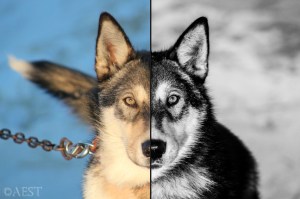
Photo courtesy of AESThetic Photography

*For a great perspective on plans vs. resolutions check out the recent post by Steve Keating – Plans or Resultions?

Leadership of the Heart

IceCanoeBy data I know.
By reason I trust.
By faith I believe.

As a leader,
I can use data to convince people to follow.

As a leader,
I can use reason to persuade people to follow.

But in a place beyond logic and reason,
when people have faith in me as a leader and belief in the vision,
then leadership of the heart occurs.

This requires relationship.

To lead by heart is an honor.
But more so it is humbling, for leader and follower together
serve a purpose greater than any one alone could ever realize.

When you follow, follow your heart,
and choose your leaders wisely.
And when by heart you are chosen to lead
grab hold of that which you could never possess

and lead on!

Gratitude, Pretzels and a Forest Road

The road through the forest wasn’t giving me any opportunities to pass. I was stuck behind a fellow pulling a trailer, and he was plodding along. While I appreciated the extra time to enjoy the beauty of nature around me, I was getting impatient. Eventually we came to a spot where he was able to pull over and let me by. To show my gratitude for his kindness I reached over to wave to him as I passed.

Problem 1: I was snacking on pretzels at the time, and had some in my hand. When I raised my hand to wave to the gentleman, only one finger came up. And it was not a good finger. So my wave of gratitude accidentally turned into an obscene gesture. I wanted to tell him thank you, but instead I flipped him off.

Problem 2: My teenage son was with me, sitting in the passenger seat. When I reached across the car to wave, my inadvertent gesture was right in front of his face. “DAD!” screamed my horrified son, “He was trying to help you!” “I know,” I replied, choking on my pretzels and humility, “I didn’t mean to.”

Whether or not it is the Thanksgiving holiday where you are, this is a good time to give thanks.  It’s always a good time to give thanks. If there is someone who has been kind to you, express your gratitude. It may not go perfectly, but don’t worry about it. Make the effort. Say thanks.

“Feeling gratitude and not expressing it is like wrapping a present
and not giving it.”  William Arthur Ward

Image: pixbox77 / FreeDigitalPhotos.net

When the Do Falls

Life isn’t lived in a straight line.  There are bends we plan for and hairpin twists we never see coming.  These changes in course have an impact on our life, for they are the stuff of life itself.

In the Be-Do cycle our doing flows from our being, and enriches our being. When that is in place it’s a cycle of growth. But a change in what we do can have a significant impact on the cycle.

Milestone life changes such as graduation, marriage, a new job, moving or retirement are events we look forward to with joy and anticipation.  But they can have unexpected effects if we don’t stop to think through how life will be different afterwards.  Being promoted to a new job brings new opportunities, but can also mean leaving behind relationships that affect our lives in ways we don’t realize.

Profound events such as the unexpected loss of a job or the death of someone close to us can really shake us up.  One day our normal routine comes to a screeching halt, and we’re no longer doing what we were doing before. The most severe, punch-in-the-gut experiences can even leave us with a hole in our life that can’t be filled, where there is no new lifestyle that will provide the activities that allow the same expression and enrichment of who we are. It’s a time when we really need to dig deep and get a good hold of who we are.

Expression

What we do is an expression of who we are.  When what we do changes it can take away a channel for us live out who we are.  The key thing to remember in times of such change is that what we do does not define us.  It should reveal us and reflect us, but we are who we are, not what we do.  Even though what we do is changing, we are still who we are.

A change in our doing actually provides a good opportunity to step back a moment and reflect on who we are.  Am I who I think I am? What are my core values? Are my new activities true to these values? Do I need to adjust my vision? How was I living out who I am prior to the change?  In what new ways can I live that out?

Enrichment

What we do should enrich who we are.  This is where a disruption to Do can really be hard.  When we lose a source of enrichment and fulfillment in our lives it can have a major impact on our being.

Again this is a good time to reflect.  What benefits and blessings was I receiving from what I was doing before?  Which were the most meaningful to me?  What would my life be like without that?  Can I find another source in my new activities, or start another new activity that would provide what I need? If a new job isn’t supplying an important element of enrichment for me, can I find it in a volunteer activity?

As a leader

Leading is guiding people forward and bringing about change.  But change for people often means a change in what they do.  As a leader it is important to be aware of the impact this has.  If the leader has built this change upon communal values and shared vision, the new actions will provide the people an even better means to live out who they are,  and will enrich who they are in new and wondrous ways.  However, if the change brought about by a leader only interferes with the Be-Do cycle of the individuals, then the individuals will not grow, and neither will the team or organization.

When life takes a turn and there is major change in what you normally do – Hold onto who you are. Seize the opportunity to better understand and even refine who you are. Reflect on how to live that out. Seek new means of enrichment, in order that you may become all that you are meant to be.

“The only way to make sense out of change is to plunge into it, move with it, and join the dance.” Alan Watts

Photo courtesy of AESThetic Photography

The Mythical Pyramid of Leadership

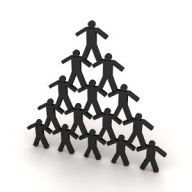
“Flatten the pyramid!”  While the call to reduce or even eliminate the pyramidal management structure is nothing new, I have noticed it gaining volume of late.  The new generation of employees demands a less bureaucratic reporting structure, states one recent article.  The current speed of business requires a leaner operation, says another.  Often referred to is the company Valve, which has no hierarchical management structure at all.

What strikes me, though, as I look at the details of the demands is that at the core of the issue this isn’t even a matter of management.  It’s about leadership.  A reduction of management is not what people are truly seeking, even though they say it is.  Rather their aim is an expansion of leadership.

Our concepts of leadership and management are too closely interwoven.  Career success is to get as high as possible on the managerial pyramid, and the person that’s ahead in the race is therefore the leader, right?  Really?

Leadership is not about rising above others, it’s about lifting others up. 
Leadership isn’t about getting ahead of others, it’s about moving others forward.

People want to make a difference.  They want the freedom to lead.  But when leadership is falsely woven into the managerial pyramid it denies the opportunity for all but a few.  Leadership needs to be recognized as distinct from management.  Yes, managers should be expected to be leaders.  But so should those not in management.

When leadership is seen for what it truly is something amazing happens.  The leadership pyramid goes away.  Leadership is not a position.  And if there is no position, there is no pyramid.

Each organization needs to determine the management structure best for them, and as long as leadership isn’t tangled into this they’re fine.  In an organization with a culture that allows everyone the opportunity to lead, regardless of title or position, the managerial pyramid is turned from a blockade of bureaucracy to a stepping stone towards greatness.

No more personal leadership

Up until a recent moment of epiphany, I would often use the phrase “personal leadership” to describe my type of leadership.  The intent was to distinguish it from organizational leadership.  Then one day I realized it was inappropriate for me to use the phrase, for a couple reasons.

First of all, using “personal leadership” and “organizational leadership” is counter to my vision.  When people refer to organizational leadership what they are typically referring to is management.  Key to my vision is universal recognition that leadership is leadership and management is management, and while the two are closely related they are distinct concepts. If leadership happens within an established organization, it’s leadership. If leadership happens outside an organization, it’s leadership. If a leader is a manager, it’s leadership. If the leader is not a manager, it’s leadership. Let’s just call leadership leadership.

Secondly, to say “personal leadership” is redundant.  If it’s not personal, it’s not leadership.  All leadership begins with leading oneself, is built on trust and relationship, and is brought about through influence.  That’s personal.

On the about page for this blog there is still a reference to “personal leadership.”  I will be changing that soon.  What this blog is about, what I am about is – leadership.

“The place to improve the world is first
in one’s own heart and head and hands.”
Robert M. Pirsig

Photo courtesy of AESThetic Photography

Leaners, Leaders and Suckers

Leaners.  Leaders.  Suckers.  In the summers that I worked on a tree farm those were the three things we looked for as we walked up and down the rows of young trees.
If a tree was leaning it needed to be straightened so that the trunk would grow straight.  This was done by strategic tugging and stomping the dirt around the tree.

A leader in tree terms is at the very top.  There needs to be one strong point growing upward.  If there are two branches at the top it creates a fork which weakens and shortens the tree.  One branch has to be clipped back and the other tied over to direct it upwards.

And we would rub our hands up and down the trunk to remove the suckers, the little lower branches that only take nourishment away from the important upper branches.

For leaders, in people terms, there are lessons in the trees.

Straighten the leaners: If the team or individual is leaning off course, the leader needs to use some strategic tugging to get everyone back on track.  Readjust the foundation to keep everything headed in the right direction.

Set the leaders (trees): The leader (people) needs to make sure the team has at some point a singular focus.  If there is a divided sense of purpose one needs to be pruned back and the other strengthened.

Remove the suckers: All those little tasks that keep us busy and take time away from us and the team need to be brought to attention and kept in check.

————————————————————————–

“Character is like a tree and reputation like a shadow. The shadow is what we think of it; the tree is the real thing.”
Abraham Lincoln

Image via nvtrees.com

Bonus quotation:

“As the poet said, “Only God can make a tree” – probably because it’s so hard to figure out how to get the bark on”
Woody Allen

This is my Kala Patthar

This is my Everest (T.I.M.E.).  That slogan has provided me inspiration when facing large challenges in my life.  More importantly it serves as a reminder to fully experience the journey.  It is particularly meaningful to me this time of year.  The inspiration comes from my cousin, Lute, who was part of the first American expedition to climb Mount Everest, reaching the summit himself on May 22nd, 1963.  In the talks he gave later he would tell people that everyone has their own Everest.

When it comes to leadership, however, I have a slightly different perspective, and the mountain that comes to mind is Kala Patthar.  It is not the height of Kala Patthar that earns the mountain its distinction.  While the summit is a lofty 18,192’ (5545m) it is overshadowed in the Himilayas where it stands.   What is notable about Kala Patthar is the excellent view it provides of Mount Everest, which stands at 29,029’ (8848m).

The leadership vision I hold for the world is grand in scope and ambition, and is not a vision I expect to ever see come to reality, not in my lifetime.  I cannot even fully imagine what the world would be like if these principles became the norm and not the exception.  And there is so much I need to learn about leadership.  My hope is that in my lifetime I will at the least come to a point where I can fully envision and articulate what the reality would look like.

This is my Kala Patthar.  To fully experience my own leadership journey.  And then to some day stand and look off to the lofty heights and see the possibilities for a world that universally embraces principles such as these:

  • Leadership and management are seen as unique concepts, distinct from each other, to the benefit of both.
  • Leadership is on PAR – each and every person has the Permission, Ability and Responsibility to lead when a situation calls upon them to do so.
  • Managers are not seen as the victors, the ones who achieved their prestigious post as a reward for being the best at what the organization does. They are not seen as leaders simply because they are ahead in the race up the ladder. Managers are managers because they are the best at managing. Leaders are leaders because others have chosen to follow and they have accepted their responsibility to lead.
  • A person’s value to an organization is assessed only in the context of their intrinsic worth.
  • Being and becoming precede doing and achieving.
  • The primary intent of doing and achieving is to become more from it.
  • Doing and achieving produce results never before imagined when based on a foundation of being and becoming.
  • Leadership is primarily a matter of the heart, based on compassion for another as they are, and passion for what we can be.

What is your Everest? What is your Kala Patthar?

Image: www.yatlik.com/34525/index.html

Red Wings, Whitethroats and purpose

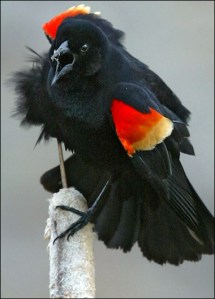
When the male Red-Winged Blackbirds first arrive in spring they are relatively relaxed, and even gregarious at times.  But when the females arrive a couple weeks later suddenly the males are aggressive and their KonKaRee call becomes raucous.  You can tell when the ladies are back in town just by observing the change in behavior of the guys.

When the White Throated Sparrows come through in the spring they sing “Old Sam Peabody” with pure tone and precise pitch.  In the fall when they come back through they sing the same song, but the pitch is all over the place, and they put no effort into it.  The song that’s so beautiful in the spring is hilarious in the fall.

What makes the difference?  Purpose.  The analogy may be obvious but I will state it anyway, birds and people are alike in this regard.  A clear task spells out exactly what to do.  A clear goal gives direction.  A clear purpose bolsters tasks and goals to the Why power.  Purpose shows why to do that task and why to take that direction.  When people have a clear task with a clear purpose towards a clear goal they sing a different tune.

“Purpose is what gives life a meaning.” Charles H. Perkhurst

Image: Vail Daily, Preston Utley / AP Photo

What a leader is not

OppositesWhat is the opposite of a leader? What word comes to your mind in response to that question? Pondering what something is not can help one better understand what it is.

Would the opposite of ‘leader’ be ‘subordinate’? ‘Direct report’? No. Leadership is not found on an org chart.

Is it ‘follower’? I say no. Many of the qualities of a good leader are also qualities of a good follower. And both are moving together towards a vision.

Is it ‘victim’? Not in terms of someone who gets knocked down, but if they stay down and take a victim mentality then they are the opposite of a leader. A leader steps forward to make a difference in life. A person who plays the victim sees life as something that happens to them.

Is it ‘bystander’? If not the opposite of a leader it at least describes one who is the opposite of a leader. A bystander isn’t even following, they’re drifting through life. They’re on the sidelines at the end of the bench with their earbuds in. Leadership is not passive. A leader is in the game.

What it comes down to is that I can’t think of a single word that fits perfectly as the opposite of ‘leader’.  But then I’m not seeking a word as much as an understanding. That’s why I would love to hear what you think. Can you think of a word that’s the opposite of ‘leader’?

“Leadership exists when people are no longer victims of circumstances
but participate in creating new circumstances.”
Joseph Jaworski

Image: scottchan / FreeDigitalPhotos.net