Future leaders? Today’s leaders!

In the summer between his Junior and Senior years of high school our youngest son kept talking about how excited he was to be captain of the school’s Ultimate Frisbee team in his Senior year.  I finally said to him one day, “You know, you haven’t officially been named captain yet.  What happens if you aren’t named captain?”  Without any hesitation or concern he replied, “That’s ok.  I can still be a leader.”

He said it knowing full well what that meant.  Leadership is about passion, not position.

That next school year he was named co-captain along with two others and they were all great captains and great leaders on the team.  It was awesome to see the team finish fifth in state that year.  It was even more awesome to see everyone on the team grow and develop as players and as people.

Whenever young people step forward to make a difference in their world it is a beautiful thing.  It’s reassuring and inspires hope.  But to hear them referred to as “future leaders” or “leaders of tomorrow” causes me to bristle a bit.  Yes, I expect they will be leaders in the future.  But they are also leaders today, here and now.  Whether or not they will be managers some day is irrelevant.  To refer to them simply as future leaders discounts their present leadership.  They may still have a lot to learn about leadership.  Don’t we all?  So instead of calling them future leaders, let’s just call them leaders.

Photo courtesy of my youngest son
at AESThetic Photography

Burnt out? Check your pilot light.

Exhausted? Unable to concentrate? Struggling to get motivated? These are classic signs of burnout. The vision is that of an engine that has been running too fast too long and finally goes up in smoke, leaving the car to sputter to the side of the road. But a better image may be of a pilot light that has flickered out. If you’re feeling burnt out the problem may not be that you’re having to put too much into what you do, but rather that you’re not getting enough out of it.

For several years I was on a committee at work that was very active and productive. It was not part of my regular job, so it had a volunteer nature to it. It required extra time and energy on my part. After the committee ended I noticed something unexpected. I felt burnt out. Why, I wondered, would I feel burnt out now when I have more time available and not back when I was in the thick of it with that committee?

It was because I was getting more out of being on that committee than I was putting into it. It allowed me to act upon values that are important to me. It challenged my ways of thinking. I learned about myself, and about how people relate in a corporate environment. It was hard work but I grew from it.

If you’re feeling burnt out, take a break, at least for a moment. Don’t just take a break to rest and let the ashes cool. But take a break to check your pilot light. Take time to simply be and to think. Who am I? What am I doing and why am I doing it? How does what I’m doing fit with who I am? Is it in alignment with who I am, does it express who I am? In doing what I am doing am I enriched by it? Am I growing?

Is there something I am doing that I should stop doing, because it demands much of me but doesn’t really fit with who I am? Is there something I am doing, perhaps something I have to do, that I just need to better understand why I am doing it? And here is a really odd question to be asking yourself in a time of burnout, is there something I am not doing that I should be doing, something rewarding and enriching that would keep my pilot light going?

Keep a light on!

“Stress is not the enemy. A lack of refueling and renewing and recovery against the stress you face every day at work is really what depletes your resources & causes you to lose your productivity, to lose your momentum, to lose your motivation, to lose your energy.” Robin Sharma

Image: Suvro Datta / FreeDigitalPhotos.net

Shut the door! It stinks! – a lesson in communication

One spring the mugo pine in front of our house became infested with worms that were eating the needles off the bush. I decided to take the manly approach to get rid of them – chemicals. Well, using a shotgun would have been manlier. But when you use firearms for insecticide it slows down the recovery time of the plant.


On returning home from the store with the liquid weapon the label said (I know, not manly, I read the instructions, I admit it) that it was in concentrate form to be mixed with water (good thing I read the label). As I mixed it up the concoction smelled absolutely horrible. The odor itself would have been enough to fend off worms, wolves and most small invading armies. Carrying the potion over to the bush I walked past the front door of the house. I noticed that the door was wide open. I didn’t want the terrible smell to get inside so I yelled in to my wife, “Shut the door! It stinks!”

After I had committed the application, cleaned up and got everything put away safely I went in to talk to my wife. Our conversation revealed something interesting. When I had yelled in through the door, she was not aware that I was working with an odiferous chemical. What I was not aware of was that she had been singing as she was doing spring cleaning. So here she had been on a beautiful spring day, working with the door open to take in the fresh air, singing joyfully as she went and I yell in, “Shut the door! It stinks!”

Fortunately she realized that I could not have possibly meant what she heard me say. She knew there had to be more to the story. Had I yelled in, “Please close the door so this awful smell doesn’t get in the house,” would have raised other questions for her about me, but would have been more effective.

I learned a lesson in communication that day. It’s not just about the message that’s delivered. It’s about the message that’s received.


What’s better than engagement?

Employee engagement is held up as a key element to corporate success. It is important that employees have a sense of connection with the organization. But what about connecting the organization to the employee? What about the rapidly changing work environment, is employee engagement still enough? Or is it time to focus on something more?

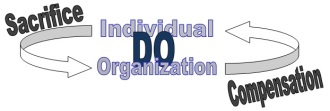
While the general concept of engagement is a wonderful thing, unfortunately it is often regarded in a mechanical view of the corporate world: The Do loop of sacrifice & compensation. In this context the very word “engagement” takes on its mechanical connotation. A clutch is something you engage. Employee engagement seeks to make sure that each individual gear is meshed smoothly with the corporate cogs.

With a line drawn between work and life there is no real balance to be found between the two. How can an employee be engaged at work when they are forced to leave life at the door? What does it matter when what matters doesn’t matter?

And the situation degrades further when economic conditions worsen. The work side gets jammed with more pressure to Do, and employees are just thankful to have the problem and not the less fortunate alternative. Too often employees are thought to be engaged in their work when all they are is married to their job.

It’s important that employees are personally connected with the organization. But if people aren’t able to fully be who they are in their work, the most that engagement will ever produce is mediocrity. Real success is not found in connecting the individual to the organization.

The key is in making sure that within the organization
each individual remains connected to who they are.

So, what goes beyond employee engagement?

It’s not just about engagement; it’s about expression & enrichment: The Be-Do loop. Is an individual able to work in a way that builds upon and expresses who they are? Are individuals enriched by their work, do they become more from what they do?

“The highest reward for a man’s toil is not what he gets out of it
but what he becomes by it.”
  John Ruskin

This isn’t a management issue. It’s not an HR issue. This is a leadership issue, and that means it’s the responsibility of each individual who comprises the organization. In the network of relationships and interactions each person must be wholly regarded and respected for who they are, not just perceived as the piece of them that shows up for work.

What are your suggestions? How do we go beyond engagement to create a more fulfilling workplace? Are you engaged in your work? Is your work an expression of who you are? Are you enriched by your work? Are you there to make a living or to make a difference? How does an organization create a corporate culture that recognizes each individual for their intrinsic worth and not just their value to the corporation? What’s better than employee engagement?

Photo courtesy of AESThetic Photography

Dooby Dooby – Be Do Be Do

Rivers and RoadsBE  Set aside the to-do list for a moment.  All those tasks waiting for you, they can wait a bit longer.  Any concerns you may have about the perceived importance of the work you do, let it go.  Pause and ask yourself a couple questions – Who am I?  Who do I want to be?

Dig a little deeper: What are my values? Beliefs? My vision? My perspective on the world around me? My gifts and talents? What are the key experiences and memories that have shaped me? In what areas am I particularly knowledgeable? What relationships are most important to me?

While the world focuses on what we do, as discussed in the previous post, everything really hinges on who we are. This is the starting point. Before you can effectively assess what you want to do, you need to have a clear understanding of who you are and who you want to be.

The doing is indeed important, of course. If we didn’t do anything the world would quickly come to a screeching halt and we would be rather bored. However, what we do needs to flow from who we are. Doing needs to spring from being. Our actions should build on our gifts and talents. Our decisions need to be in alignment with our beliefs and our values.

What we do should also be an expression of who we are. What we do does not define us, but it should reveal us. If what we do does not paint an accurate picture of who we are then we are not being authentic. It’s an indication that our doing is not in alignment with our being. This is not sustainable, and it will eventually reveal something else about who we are.

Connecting this all together in a powerful way, what we do should in turn enrich who we are. What we do should reinforce or refine our values, increase our knowledge, improve our abilities. The primary purpose of doing is that we become more from it. When all this is in place it creates a cycle of growth.

Unfortunately, this can also become a cycle of decline. When what we do is not true to our values, or when our doing only drains us and pulls us away from what is important to us, then it becomes a downward spiral. We become less from it, and in turn are able to do less. We don’t become all that we are meant to be.

Once you have a clear understanding of who you are and who you can be, then pick up that task list again. For each item on the list ask yourself, is what I’m doing and how I do it true to who I am? Is it in alignment with who I am and express who I am? Does what I do and how I do it enrich who I am? Does it affirm my values and lead me towards my vision? Do I learn from it? Does it challenge me to become even more than I am now?

I am not who I am because of what I do.
I do what I do because of who I am.

Photo courtesy of AESThetic Photography

Do

DO  The world pivots on that little world.  Days are structured around to-do lists, lives lived with dreams of what we want to do.  We are defined, categorized and ranked by what we do.  You meet someone new and one of the first questions you will ask each other is, “So, what do you do?”  Ads remind us to “Just Do It.”

To make our doing more efficient the Industrial Age grouped individuals into organizations, each individual plugged into their part of the machine.  The engine that drives the machine is the premise that the individual will sacrifice their time and energy for the organization.  In turn the organization will compensate the individual.  Ever wonder why it’s called compensation?

Do Loop

Fueling the engine is the concept that the more an individual sacrifices for the organization, the more they will be compensated. And from the other side, the more the organization compensates the individual, the more they will sacrifice. Trouble is,

Employees are people.
And so are organizations.

What also gets sacrificed in this model is each person’s full individuality. So much of the stuff of life just doesn’t fit into the organizational machine.  We draw lines at the beginning and end of the day, and at the end of the week, with ‘life’ on this side and ‘work’ on the other.  And employees put up pictures at work to remind them of their real lives.

Unless your goal is to be the biggest gear in the corporate machine, dreams of what you really want to be doing, of what really matters to you, get thrown off to the side into a bucket labeled “Someday.”  Someday I’ll take up that hobby.  Someday I’ll spend more time with my family.  Someday I’ll take that trip.

Isn’t there a better way?

What if there was no such thing as work-life balance,
but rather work was just part of the richness of life? 

Isn’t there some way we can get done what needs to be done without dehumanizing people?  I believe there is.  Beginning with the next post we will begin exploring the Be-Do model, another way to look at how the world works.

RICH goals

Did you set goals for 2012?  If so, did you use the SMART criteria?
Specific – Measurable – Attainable – Reasonable – Time-based

The good thing about using the SMART criteria is that it gives some traction to our goals.  The down side is that they are focused on our actions, and the outcome of those actions.  To put real power into our goals we need to look first at who we are and who we want to be.  From there then we can align our actions to our being, and build what we do from who we are.  Realizing the full potential comes when we take it the next step and complete the cycle by assessing whether our actions enrich who we are.

Before you evaluate your goals to see if they’re SMART, first consider whether your goals are RICH.

R – Right
Is what I’m doing and how I do it consistent with my values?

I – Influential
Does what I’m doing and how I do it have a positive impact not only on myself but on others as well?

C – Challenging
Does what I’m doing and how I do it challenge not only my abilities but also my way of thinking?

H – Heart thumping
Does what I’m doing and how I do it make me alive? Do I approach my work with the attitude, “Let me at it! This isn’t just about making a living, this is about living! Bring it on!”

Here’s to a RICH and SMART 2012!

“You may say, ‘I’ve tried so many times before, but nothing seems to happen.’ That’s what the mountain climber could have said after three failed attempts to reach the top of Mount Everest. Instead, he looked up at the summit and announced, ‘You defeated me once. You defeated me twice. You defeated me three times. But mountain, I will someday conquer you, because you cannot get any bigger, and I can.’ ”

Neil Eskelin

S.A.R.

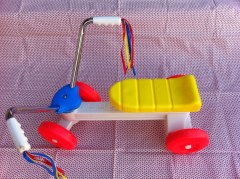
When our daughter was a wee tot we bought her a 4-wheel scooter for Christmas.  It unfortunately came with those three dreaded words, “Some assembly required.”  Giving it to her in the box and letting her put it together herself would have been an option. But I really didn’t want to have her using my tools at her young age, and run the risk of her showing me how they’re supposed to be used.
So I set about assembling the thing myself.  In the process of jointly building a scooter and character, I discovered a part was missing.  The instructions had an address to write to if a part was defective or missing.  I put the new toy together without the part for Christmas, and then sent the company the following letter.

Twas the night before Christmas and under the tree
Sat a Playskool Tyke Bike, a screwdriver and me.
The bike was in parts all snug in its box.
I began to assemble it with no major shocks.

When all of a sudden there arose such a clatter.
My wife ran to the room to see what was the matter.
“I can not complete this!” she heard me to say,
“I’m missing part 231-21a.”

Well, I put it together the best that I could,
Though my poor daughter could not steer it so good.
So you see, you would be a dear friend,
If part 231-21a you would send.

One day a package arrived in the mail.  I was surprised by the size, it was larger than the part I had requested.  On opening it I saw they had sent not just the part but a new bike.  It too needed to be assembled, but that was fine with me.  In the package was a form that the company used to indicate which part they were sending.  The form was crossed out, and handwritten across the bottom was the note, “Send whole unit.”

May your Christmas be completely merry, even if it’s not completely perfect.

Let the leaders lead!

Too often a situation calls upon a person to lead, but they do nothing.  They incorrectly assume that leadership is a position, a position they’re not in.  So they wait, wondering why ‘someone’ doesn’t do something.

Too often a person is restrained from showing leadership by an insecure manager that feels threatened by the person’s attempt to lead.  The manager incorrectly assumes that leadership is a position, their position, and the person must be after their job.  Or the manager is just afraid that if the person leads, the manager will lose control, control they don’t have anyway.

Too often a person steps up to lead and they struggle.  They’re not prepared because the leadership training was reserved for those in management.  And when the person tries to find information on leadership, the material in the category of “Leadership” is really about management, and the good material on leadership is categorized under “Management.”

Too often a person steps up to lead, does well but then gets no credit for it.  Others incorrectly assume that leadership is a position, and that person is not in such a position, so it must have been someone else who made the difference.  And it is sad when the person who led well is discouraged by the whole thing, and hesitates the next time they’re called upon to lead.

It is not often at all that someone is an excellent manager and an excellent leader.  But too often these rare folks aren’t recognized for their leadership ability.  People incorrectly assume their leadership skills are part of their position as a manager.  And the manager/leader never achieves the full measure of their incredible potential.

There is a shortage of leadership.  However, there is no shortage of leaders.  So many leaders are unfortunately trapped by misconceptions around what leadership is and is not.  If we could find a way to untangle the passion of leadership from the position of management, it would free people to be the leaders they are called to be.  And the world would find the leadership it seeks, not just from those in authority, but from people all around.  And most importantly we would find it in ourselves.

Management is a job.  Leadership is life.

3 Leadership Lessons from a Norwegian Bachelor Farmer

Uncle Harold was a Norwegian bachelor farmer from Central Minnesota, about 40 miles west of Lake Wobegon. He was a patient, gentle man, and it showed in his unique method of bringing the cows in from the pasture.

Typically a farmer will get around behind the cows and drive them towards the barn. But Harold would go out to the pasture, gently get the cows’ attention and begin walking back to the barn, with the cows following behind. If the cows stopped to graze for a while, Harold would sit down and smoke his pipe, and wait. When the cows were ready to continue he would get up and start walking towards the barn again.

Uncle Harold was just going out to get the cows, but he provided a beautiful model of leadership.

1. Too often people think they’re leading when all they’re doing is driving the herd.

2. What a difference it makes when the destination is reached, and the followers are there because they chose to be; because they understand it’s where they need to be; because they trust the one they chose to follow.

3. How you work with the cow in the barn determines your ability to lead the herd in the pasture.

“The leader leads, and the boss drives.”  Theodore Roosevelt