2.2%. That is the percentage of people in the US who are managers.*
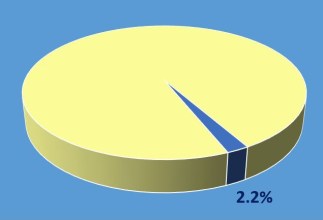 Can we afford to suggest that only managers can be leaders? No. The need for leaders is far greater than 2.2%. But every time the word ‘leader’ is used as a synonym for ‘manager’ it sends a message that the other 97.8% cannot be leaders simply because they are not managers. And when ‘leader’ is used to refer to an executive manager it restricts the number even further down to 0.76% of the US population.
First of all it is unfair to managers to expect that they alone can fully meet the needs of leadership, especially considering that typically they are already laden with immense responsibilities. And it’s unfair to all those who want to make a difference but are inhibited from doing so simply because they don’t have an acceptable job title.
What percentage of people should see themselves as leaders? 100%! The longing to matter and make a difference is part of our inherent need to adapt and grow. To suggest to anyone that they cannot be a leader denies them the opportunity to live a fulfilling life.
43.6%. That is the percentage of the US population that is employed.*
Can we afford to suggest that leadership only happens in the workplace? No. The need for leadership is greater than 43.6%. Leadership doesn’t have to happen within an organization. Leadership happens in relationship, in the space between one and another.
Leadership is about so much more than business. Leadership is life size. It can come from anyone and it serves everyone. We need to talk about how leadership happens within organizations but it is just as important to talk about how leadership happens outside of organizations.
Whenever you use the word ‘leader’ or ‘leadership’ make sure that you are indeed talking about leadership. Call it what it is because it matters. The need for leaders and for leadership is far too great to stuff it inside a few boxes on an org chart. The need is 100%.
* The numbers are based on the 2017 US population compared to the “May 2017 National Occupational Employment and Wage Estimates.” www.bls.gov/oes/current/oes_nat.htm While the numbers are only for the US the concern applies globally.





 “What a lousy day,” says the golfer.
 A characteristic we all share is that each of is different. Diversity is the life reality of who we are as a collection of unique individuals. This reality presents challenges but also immense opportunities. A Servant Leader is well equipped to address the challenges and to build on the opportunities, particularly in three key areas.
 “What are your top three leadership core values?” It was a thought provoking question and responding to it was a challenge. Tal Shnall posted the question on Facebook and tagged a group of us. Thank you, Tal, for the question.
 We like to live in a black and white world with clear delineation between what is good and what is bad. Everybody goes onto either a nice list or a naughty list. And so we draw vertical lines on our world. We put the bad people on the other side of the line and the good people we collect on our side. And we keep drawing vertical lines until those lines become fences and walls and bars.

 It was time to celebrate. The Minnesota Twins had won the 1987 World Series. There were two victory parades, I went to the one in Saint Paul. As expected the crowds were incredible. The best spot I could find left me about ten feet back from the street with a solid wall of people in front of me. Standing next to me was a lady and her young son. We chatted a bit as we waited for the parade to begin.
 Cybuhr